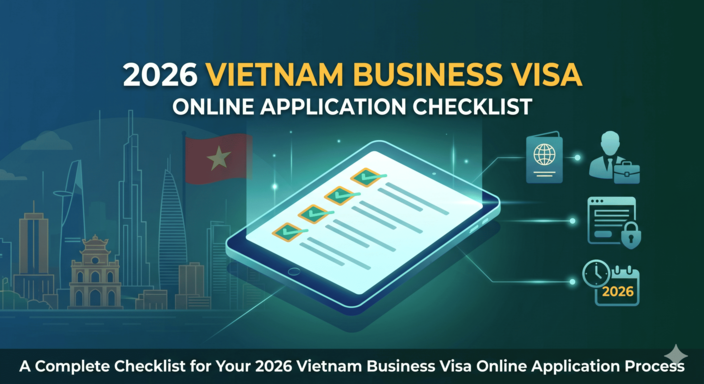
A Complete Checklist for Your 2026 Vietnam Business Visa Online Application Process
The secret to a guaranteed 2026 Vietnam business visa isn’t just filling out forms; it’s mastering the new precision-based portal requirements. Most applicants fail because their biometric uploads or sponsorship details don’t align with the latest 2026 standards. We are breaking down the complete checklist you need to navigate the high-stakes approval process with total confidence and zero delays.
One minor error on your 2026 Vietnam business visa application could cost you months of planning and thousands in lost revenue. As digital tax code requirements and biometric compliance standards become more stringent this year, are you absolutely certain every document in your package will pass the automated audit? This guide audits every mandatory item so you don’t have to find out the hard way.
Stop struggling with bureaucratic confusion and the frustrating updates on the new 2026 application portal. We have reviewed every mandatory document required for the current Vietnam business visa process to bring you a foolproof, step-by-step roadmap for approval — from digital tax validation to precise entry port alignment. This is your professional guide to a seamless, high-stakes approval.
What Is the 2026 Vietnam Business Visa — And Why It’s More Demanding Than Ever
The Vietnam business e-visa is formally categorized under the DN visa class — specifically DN1 for company-sponsored applicants and DN2 for those conducting independent business activities under international trade frameworks. It is legal authorization to enter Vietnam for meetings, conferences, trade fairs, short-term assignments, and corporate negotiations.
What changed going into 2026 is the pressure of precision. The evisa.gov.vn portal now runs automated validation against uploaded documents at submission — not manually, not later, right at the moment you hit submit. Portrait photos that fail biometric ratio checks are rejected instantly. Passport scans with low resolution or shadow interference get flagged before a human ever reviews the file. Corporate sponsorship documents without valid tax codes trigger a hold that can stretch processing from 3 business days to indefinite.
This is not bureaucracy for bureaucracy’s sake. Vietnam is experiencing a significant surge in inbound business travel, particularly from Southeast Asia, Europe, and North America. The government is simultaneously tightening compliance to filter fraudulent applications while expanding the visa-exemption list under Decree 221/2025 for legitimate high-skilled professionals and investors. If your application is clean, approval is fast. If it isn’t, the automated system does not negotiate.
A Complete Checklist for Your 2026 Vietnam Business Visa Online Application Process
The Master Checklist: Every Document You Need
Treat this as an audit, not a suggestion list. Every item below is either mandatory or high-risk-if-missing.
✅ Personal Document Checklist
- Valid passport — minimum 6 months validity beyond your intended Vietnam entry date; at least 2 blank pages available for stamps
- Passport bio page scan — color scan at minimum 200 DPI; no shadow over the photo or data fields; the full page must be visible including MRZ lines at the bottom
- Biometric portrait photo — JPG format; full face, looking straight ahead; no glasses; white background; file size within portal limits (typically under 2MB); face occupying 70–80% of the frame
- Completed online application form — your name entered exactly as it appears in your passport, including middle names, hyphenated surnames, or accented characters transliterated correctly
- Registration code saved — generated immediately after you submit the form; without it, you cannot check your status or retrieve your visa PDF
✅ Business Sponsorship Checklist (DN1 Route)
This applies when a Vietnamese company or organization is sponsoring your visa. The sponsoring entity must be legally registered in Vietnam — not a shell or ghost company. The portal account for corporate sponsors requires:
- Business registration certificate — certified copy with official company seal
- Tax registration certificate — this is the digital tax code document that the 2026 portal now cross-references against the national business registry. If the tax code is expired, mismatched, or the company has outstanding compliance issues, the sponsorship application will not proceed
- NA2 form — the official request-for-entry document, completed and signed by the company’s authorized representative with company seal
- NA16 form — the authorized signatory registration form, confirming who within the company has power to submit visa requests on behalf of foreign nationals
- Introduction/guarantee letter — printed on company letterhead, signed and sealed; stating the applicant’s name, passport number, purpose of visit, and duration of stay
- Scanned passport bio page of the applicant — submitted by the company through their portal account, separate from the applicant’s own submission
✅ Independent Business Applicant Checklist (DN2 Route / E-Visa with Business Purpose)
If you are not sponsored by a Vietnamese entity — for example, you are traveling for a trade fair, investor meeting, or short-term consultancy — you apply through the standard evisa.gov.vn portal and select “Business Activities” as your travel purpose:
- Passport bio page scan (same standards as above)
- Portrait photo (same standards as above)
- Correct visa purpose selected — “Business Activities” from the dropdown menu; do not select “Tourism” even if your trip blends both, as a mismatch between stated purpose and actual activities is grounds for denial at immigration
- Entry port accurately selected — this is the single most common technical error. The entry checkpoint you list on the application must exactly match where you physically arrive in Vietnam. Airlines check this at boarding. If it doesn’t match, you may be denied at the gate
- Payment completed — government fee processed through the e-payment gateway (the portal accepts major international cards); save the payment confirmation separately
The Digital Tax Code Trap: Why Corporate Sponsorships Fail in 2026
Here is where most business visa applications stumble, and almost nobody talks about it clearly.
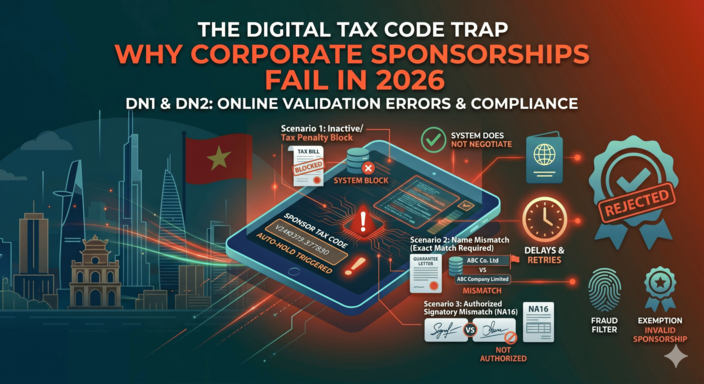
When a Vietnamese company sponsors a foreign national under the DN1 route, their portal account is flagged against the national business registration and tax database at the point of submission. This is new behavior as of the 2026 portal update. Previously, the tax code was submitted as a document and reviewed later. Now it is validated in real time.
Three scenarios kill a corporate sponsorship before it even reaches a visa officer:
Scenario 1: The tax code is listed as inactive. Companies that have not completed their annual tax declaration, or that have outstanding penalties in the system, will see their sponsorship application blocked at validation. The error message is vague. The resolution requires the company’s legal or finance team to clear the issue with the tax authority — a process that has nothing to do with the visa itself and can take days.
Scenario 2: The company name on the guarantee letter doesn’t match the registered name exactly. Vietnamese business names sometimes have abbreviated forms used in everyday operations. The portal matches the registered legal name, not the trading name. A letter signed by “ABC Trading Co.” when the registration says “ABC Trading Company Limited” triggers a mismatch flag.
Scenario 3: The authorized signatory on the NA16 form is not the person who actually signed the guarantee letter. Corporate restructuring, staff changes, and overseas management arrangements create this problem constantly. The person who signs the guarantee letter must be the same person registered as the authorized signatory on the company’s portal account.
💡 Expert Insight from Stanley Ho: “Over my 23+ years handling travel logistics and Vietnam visa services, the most common disruption I see with business visa applications is not the applicant’s documents — it’s the sponsoring company’s compliance status in the government system. Before your Vietnamese partner submits anything, ask them to verify their tax code is active and their authorized signatory registration is current. Doing that one check saves weeks of confusion. If you’re already stuck in the system and your trip is imminent, our emergency team can assess the situation and escalate through priority channels.”
Biometric Photo Requirements: Getting This Wrong Ends the Application Instantly
The portrait photo requirement is the fastest-moving target on the checklist, and the automated system has no patience for approximations.
The 2026 portal specifications for the business visa portrait:
- Format: JPG only
- Background: Pure white — not off-white, not light grey, not a blurred background from a smartphone portrait mode shot
- Glasses: Not permitted, regardless of whether you wear them daily
- Head covering: Not permitted except for documented religious reasons
- Expression: Neutral, mouth closed
- Head angle: Straight ahead — not tilted, not turned
- Lighting: Even, no harsh shadows across the face or background
- Face framing: The face and top of the head must be clearly visible; the face should occupy the majority of the frame
- File size: Check the current portal limit before uploading; oversized files are rejected at upload, not flagged for manual review
A common mistake: using a photo from another visa application for a different country. Photo standards vary significantly by country. A photo accepted by the UK, EU Schengen, or Australian visa systems may not meet Vietnam’s specifications. Take a fresh photo specifically for this application.
 Entry Port Alignment: The Step Everyone Rushes Through
When you complete the Vietnam business e-visa application, you are required to select your intended entry checkpoint from a list. As of December 2025, the e-visa approval covers 83 ports of entry — airports, land border gates, and seaports.
A critical detail most applicants overlook is that the selected entry port must match the actual arrival point. Airlines may deny boarding if the mismatch is detected.
The fix is simple in theory: select the airport or border crossing where you will actually arrive. In practice, itinerary changes cause this problem constantly. A flight rerouted through a different hub, a last-minute decision to enter by land from a neighboring country, a connecting flight that becomes a direct flight — any of these changes the entry port without the applicant updating the visa.
If your itinerary changes after the visa is approved, check whether the new entry point is on your existing visa. If it is not, you need a new application. Do not assume a Vietnam immigration officer at a different entry point will wave you through. They will not.
Vietnam’s primary business travel entry airports:
| Airport | City | IATA |
|---|---|---|
| Noi Bai International Airport | Hanoi | HAN |
| Tan Son Nhat International Airport | Ho Chi Minh City | SGN |
| Da Nang International Airport | Da Nang | DAD |
| Cam Ranh International Airport | Nha Trang | CXR |
| Phu Quoc International Airport | Phu Quoc | PQC |
Most international business travelers arrive at HAN or SGN. Da Nang (DAD) is increasingly common for mixed business-conference itineraries involving central Vietnam.
Processing Times and What “Urgent” Actually Means in 2026
Standard processing for the Vietnam business e-visa through the official portal is 3–5 working days. That is the baseline. Do not build a travel itinerary that depends on a 3-day turnaround without margin.
Real-world processing can run longer for several reasons: peak travel periods around Vietnamese public holidays, corporate sponsorship applications requiring secondary review, and technical flags on biometric documents that need manual override.
The urgent visa pathway — available through authorized service providers — compresses approval to 2–4 hours through priority processing channels. This is not a workaround. It is a legitimate service used by executives, legal professionals, and investors whose trips are time-sensitive and cannot absorb a processing delay.
If you are reading this with less than 48 hours before departure, the standard portal route is not the right option. An emergency processing pathway exists precisely for this situation. The same applies if you are already at the airport and a check-in agent has flagged a document problem — emergency e-visa clearance is possible before your flight boards.
A Complete Checklist for Your 2026 Vietnam Business Visa Online Application Process
How to Apply: The 2026 Step-by-Step Process
Whether you are applying as an individual business traveler (DN2/e-visa route) or being sponsored by a Vietnamese company (DN1 route), the core steps follow this sequence:
- Go to evisa.gov.vn — the official government portal.
- Select your nationality and travel purpose — choose “Business Activities” from the purpose dropdown; do not conflate with tourism
- Enter your personal details exactly as they appear in your passport — check the name fields against your passport three times before proceeding
- Select your entry checkpoint — verify this against your confirmed itinerary, not a planned one
- Upload your passport bio page scan and portrait photo — confirm both meet the technical specifications before uploading
- Complete the e-payment — save the payment confirmation as a separate document
- Record your registration code — this is your only reference for checking application status
- Monitor the status through the portal search function — the system sends email notifications but the portal status is the authoritative source
- Download your approved e-visa PDF when available — save multiple copies; Vietnam accepts digital and printed versions at entry
If you are being sponsored under the DN1 route, steps 4–9 above are handled through the sponsoring company’s portal account, not your personal application.
Frequently Asked Questions
What is the difference between a DN1 and DN2 Vietnam business visa?
The DN1 visa is issued to foreign nationals sponsored by a legally registered Vietnamese company or organization — the sponsoring entity takes responsibility for your entry and activities in Vietnam. The DN2 visa covers foreign nationals entering Vietnam under international trade agreements or bilateral business frameworks, where no Vietnamese company sponsorship is required. For most independent business travelers using the e-visa portal in 2026, the e-visa with “Business Activities” selected functions similarly to the DN framework for short-term visits.
How long is the Vietnam business e-visa valid in 2026?
The standard Vietnam e-visa for 2026 covers up to 90 days, with single or multiple entry options. For longer-term stays or ongoing business operations, a separate work permit and temporary residence card process applies.
My company in Vietnam will sponsor my visa. What do they need to do?
Your sponsoring company needs an active account on the Vietnam Immigration Portal with a registered authorized signatory. They will need to submit your passport scan, the NA2 and NA16 forms, a guarantee letter on company letterhead, and their business registration and tax certificates. The critical step: confirm their digital tax code is active in the national registry before they submit — this is the most common sponsorship failure point in 2026.
Can I change my entry port after my visa is approved?
Not on the existing visa. If your entry point changes after approval, you need to apply for a new visa. Submit the new application as soon as your itinerary change is confirmed — do not wait until close to departure.
What happens if my application is rejected?
The portal will return a rejection notification with a general reason code. Common rejection reasons include biometric photo non-compliance, entry port inconsistency, passport data field errors, and corporate sponsorship validation failures. You may reapply. Address the specific failure point before resubmitting — reapplying with the same documents will produce the same result.
About the Reviewer: Stanley Ho is the CEO of VisaOnlineVietnam and a recognized expert consultant in the international aviation and travel service industry. With 23+ years of experience in travel logistics and Vietnam visa services, Stanley and his team specialize in providing seamless visa solutions, fast-track airport services, and emergency travel assistance for global citizens visiting Vietnam.